

On good mornings
How many Good Mornings do we greet or greeted to on an ordinary day?

On a particular pleasant morning, I began wondering how the morning charade of good mornings and greetings varies in different parts of the world.
The first thing that comes to your mind is the reflexive greeting at the workplace or classroom, or the annoying WhatsApp forwards and quotes you get on family groups by Dads and WhatsApp-frenzy boomers. But then, there are a few simple, heartfelt Good Mornings or another form of greeting that might just make your day.
Growing up in multiple cities, it was quite surprising to see people’s various attitudes when you greet someone, or when you choose not to. Fortunately, many of my friends have moved far and wide now in countries all over the world, for their higher studies and jobs. I sent everyone the same question over text:
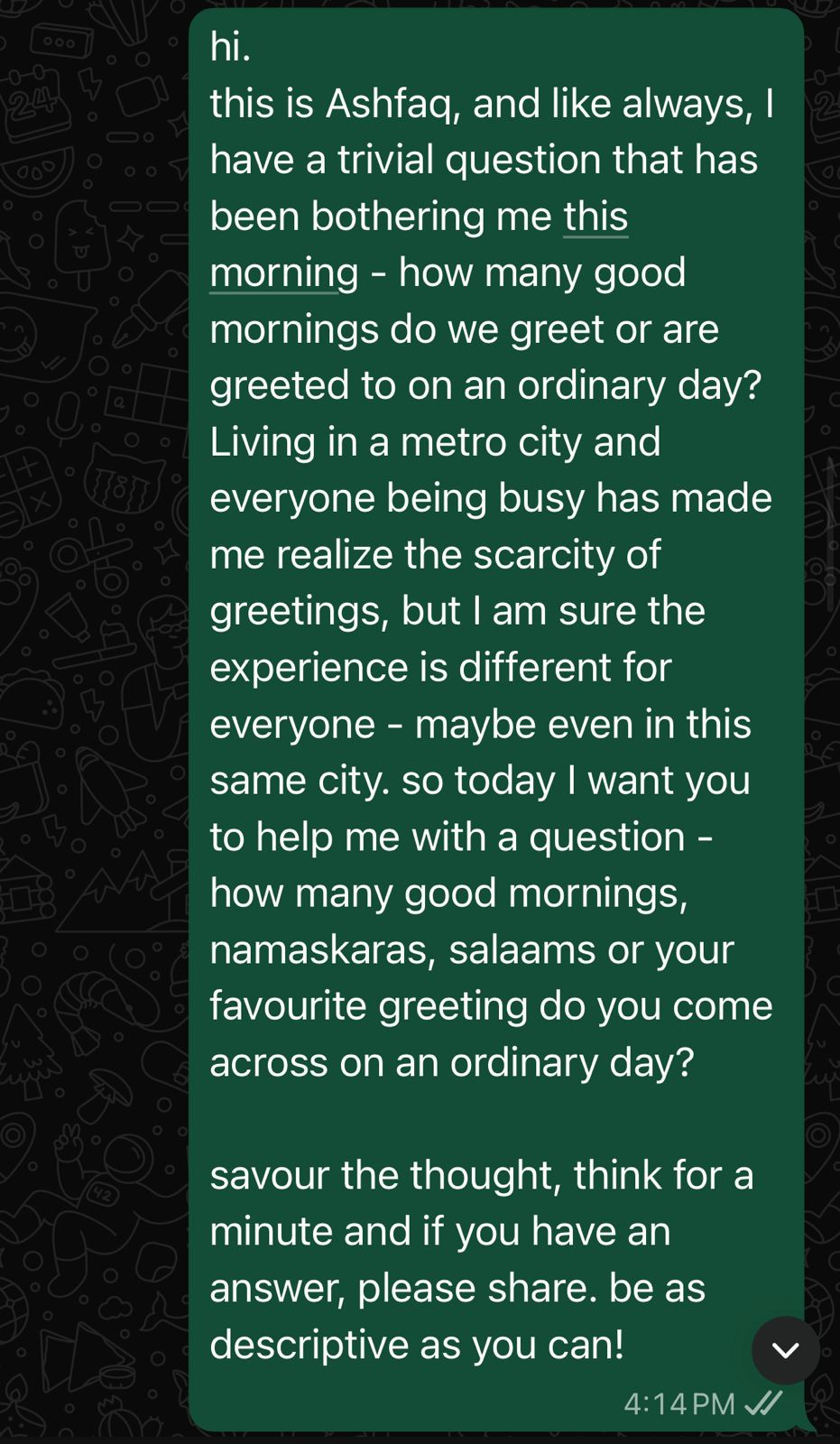
I was not sure what to expect as an answer, but what I did get was something beautiful— a collage of thoughtful, unique and beautiful answers:
My answer would have been different had I stayed back in India for a few more years after my Bachelors. I remember greeting my professors with a good morning or a good evening on a daily basis, but never with friends because that’s just too formal. It’s mostly a normal “hi” or “wassup” with my buddies. Coming to the States, that same formal greeting has become much more common. From vendors to delivery people, from friends to professors, everybody greets me with a “hello”, “salaam” or “morning”. It was definitely overwhelming in the beginning because greeting random people in the morning with so much amiable warmth wasn’t something I had practised enough. But still, my visit to the East Coast made me understand that it really depends on the kind of life the people live in that area. New York is very fast-paced, totally unlike LA. Life back here is laid back and slow. The more the skyscrapers, less the greetings. More the beaches, more the greetings….
….Some people look forward to talking. Usually the old people with just a dog, and no one else in their lives. Others are the burnt out cashiers, looking forward to a nice conversation after a boring day at work. The overstimulated ones are more reserved. You won’t get a good morning at a tennis court. You’d mostly be greeted with “Can you pass the ball?”
- Shaheer, Los Angeles
Ah interesting. So if I go to the office, I say it to all the teammates (the Japanese version of it) and my friends and any neighbours I come across. On WFH days, just my flatmate 🙆🏻♀️
At the office, we always say ‘otsukaresama desu’ to everyone you meet or work with (it’s like a way of saying thank you for your work), it’s my fav part because it’s such a versatile thing to say 🫢
- Surmai, Tokyo
I think since I live in London, it’s different. People are kinder and more polite (in other parts of the country). So yeah, if you know someone, you normally greet them (here). I greet my roommates and, of course, people I know. But the only other group of people I greet, actually, it’s more of expressing gratitude - I say thank you driver to bus drivers. Its a common practice around the UK, just a lot less common in London
- Andrea, London
I woke up to eight good mornings from my family. Four from people on the road and in the cafe. Seven from my friends on WhatsApp. And I’m still waiting for yours ….
- Sawsan, Gaza
I did ask friends from other parts of India too, two of whom replied:
Oh! I love saying Good mornings and greetings & salutations and thank yous (and sorrys). At IIT Bombay, my lab was very big. I was either the first one to come in, or I would join in only after lunch. Either way, I would greet everyone. If coming after lunch, saying “Good Afternoon everyone” was my way of saying I’m here now. I still greet a lot of people with hello, good morning. And some do get taken aback with the Good morning part. I would love if the world said a lot more Good mornings & thank yous. On that note, Good morning!
- Keshav, Mumbai (brief stint)
When at home, I’m greeted with good mornings from family. When at work, I try to say Hello or Morning to my colleagues. Oh, and at least 2-3 spam calls every day - they all start with greetings. I greet myself every day after waking up. So I guess, on an average, 5-8 good mornings every day.
- Jashn, Jaipur
And then the longest response from my eloquent friend Maryam, all the way from Singapore:
How many greetings do I come across on an ordinary day? For the past few months, as I transitioned between being a student, then unemployed, to now freshly employed, there has been no ordinary day. No routine to stick by. It’s only this week after returning to Singapore that I’ve been tuning back into a set rhythm. So maybe I’ll situate your question in the soon-to-be ordinary week that I have been having.
I stay with 3 flatmates in a cosy 2-bedroom apartment tucked away above a marketplace. The first greeting of the day is always to and from my flatmates - usually my own roommate - ranging somewhere between a groggy “good morning” to an annoyed “Your alarm, Maryam”. After a quick breakfast, I leave for the university campus I previously studied in and now work at. My Mumbaikar flatmate will give me an “Allah hafiz”, and the other two, if they haven’t left already, will pass me an “Assalamu Alaikum”.
Bus no. 95 passes right behind our block, and its route cuts right through campus. Very convenient. As I wait for my bus, sometimes an old uncle or auntie will crack a smile at me. I’ll smile back, the amount of teeth showing proportional to how stressful I foresee the day ahead to be. Or at times, I’m in my own head, speaking to myself, completely unaware of those around me. Someone once described me as a drowning ship when I’m in my own thoughts.
Drowning or not, I think people think I’m always up for a chat. Is it something on my face? I’m still figuring it out. This week, I had a Chinese uncle hit me up for a conversation. “You stay there, ah?” wagging a finger to our block across the road. I was a little confused. He continued, his words laced in thick Singlish, the Singaporean take on English (which I find very endearing), “Aiyah, you told me la.” A few minutes into the conversation, I figured that he was mistaking me for one of my flatmates, whom he had had a rather detailed conversation with. It would be too bothersome to correct him, plus I didn’t mind, so I played along. Singapore has an ageing population, and many of them stay alone; they seem eager to talk to anyone willing to lend an ear. But sometimes these conversations can take a turn too. “So how is Dubai, is it nice?”, to which I respond, “Yeah, not bad. It can get quite hot in the summer though. Otherwise, it’s pretty nice.” It’s kind of like my autopilot response to Singaporeans who I know don’t know too much about the Middle East (except that we all own pet tigers). “But got lots of Indians, right? Like millions and billions of them.” I chuckle in my head. We had already established I was Indian, but of course, what is Singapore without a sprinkle of casual racism towards Indians, who arrived in the small island city-state in many waves: ancient trade connections, during the time of British colonialism as indentured labourers, and more recently as skilled professionals during the IT sector boom. I smile, “Yeah, there are a few of us there.”
I get on the bus. Talking about greetings, I’ve seen a few people always greet the driver when they board the bus. I think it’s very sweet, maybe I should start doing it too. Once I reach campus, I walk slowly to my lab, keeping an eye out for any juniors that I may know. Usually none - campus is so big, and it’s easy to feel swallowed by the barrage of students during peak hours.
This week, I’ve been first to the lab. My prof will come in shortly after, and drop me a quick “Good morning, how are you?” I ask her how she’s been, knowing very well that she hasn’t been doing great with both her parents in and out of the hospital the past couple of weeks. I used to find her intimidating, my professor; she has a way of looking at you like you’re a tiny speck of dust. But over the 2 years that I’ve come to know her more closely, I’ve realised that she’s just a teddy bear really. But things can turn grizzly very quickly if you slack or don’t pull your weight. I can respect that. This time, she said, “I’m... okay. The surgery didn’t go well, we need to figure out what the next treatment plan is.” Watching your parents slowly wither away right in front of your eyes unsettles even one of the strongest people I know.
When I was an undergraduate student in this same lab, I’d just pick an empty seat that was available. But now that I’m staff, I have a designated spot. Soon enough, a PhD candidate, and my thesis advisor, let’s call him S, arrives. He’ll usually say, “Oh, I didn’t know you were coming in today.” Understandable because I spent most of my student years avoiding the lab like the plague, preferring libraries with open windows to the cubicled lab with no natural lighting.
Of course, there are other greetings peppered throughout the day. My parents will video call me, the auntie at the nasi padang stall will call me “sayang”, which translates to “darling” in Malay, a stranger will hold the door open for me, and the landlady will ask me if I’ve settled in. I see them all as greetings. Whatever is a greeting but a thoughtful acknowledgement of fellow human beings around you?
Some parts of the anecdotes appear very similar to my own experiences, while others are quite hard for me to imagine happening in my city. Hearing these answers, I realised I was hardly aware of how much depth lies in a simple greeting. The simple act of greeting is an intricate form of affection— it seems almost magical to me how every face breaks into a smile every time you utter the two words Good Morning, and I often think this mysterious spell works, maybe it does make my morning a little better. On that note, good morning to you!
First thing that I read today morning. Felt like people all over the world were wishing me good morning.
wow! good morninggg! first read of the day