
Numbers and Signs
An anecdote of teaching arithmetic with hand gestures

Ask an engineering graduate what Mathematics means to them, and you are most likely to get an answer that can be best described as a love-hate relationship. Like every STEM student who was mesmerised by the world of arithmetic, algebra and calculus in school, I could no longer recognise the Math I loved as we delved into properties of real numbers and number theory. And yet, last week, I, who had been long estranged from Math in my life, found myself teaching this beautiful, sophisticated language to a fourth-grade schoolgirl.
Two months ago, I made up my mind to pursue something solely out of curiosity. It was one of my flat-hunting expeditions in a quiet neighbourhood, away from the loud and crowded pockets of the city. I stumbled by chance upon a huge sign that read School for the Deaf (of course, it was longer than that, but I think it would be better not to name the school here). For the longest time, I had a deep fascination with the enigmatic and romanticised, yet far less understood language of the speechless - the Indian Sign Language (ISL).
Despite all the beautiful, elegant languages of the world, which have textual and oral richness, I find a certain beauty in the sign language that is unmatched- only in this language do you not need to part your lips nor adhere to obnoxious grammar rules. It is a language of passion and conviction, where your hands and your face and your eyes do all the talking, and where you not only express what you have to say but also emote that as well. I did not end up taking that apartment, but I couldn’t stop thinking about the school. After many, many days of sitting on that thought, I took a blind leap and decided to go up to the school one day, with the hope of finally being able to learn the language that I admired so much.
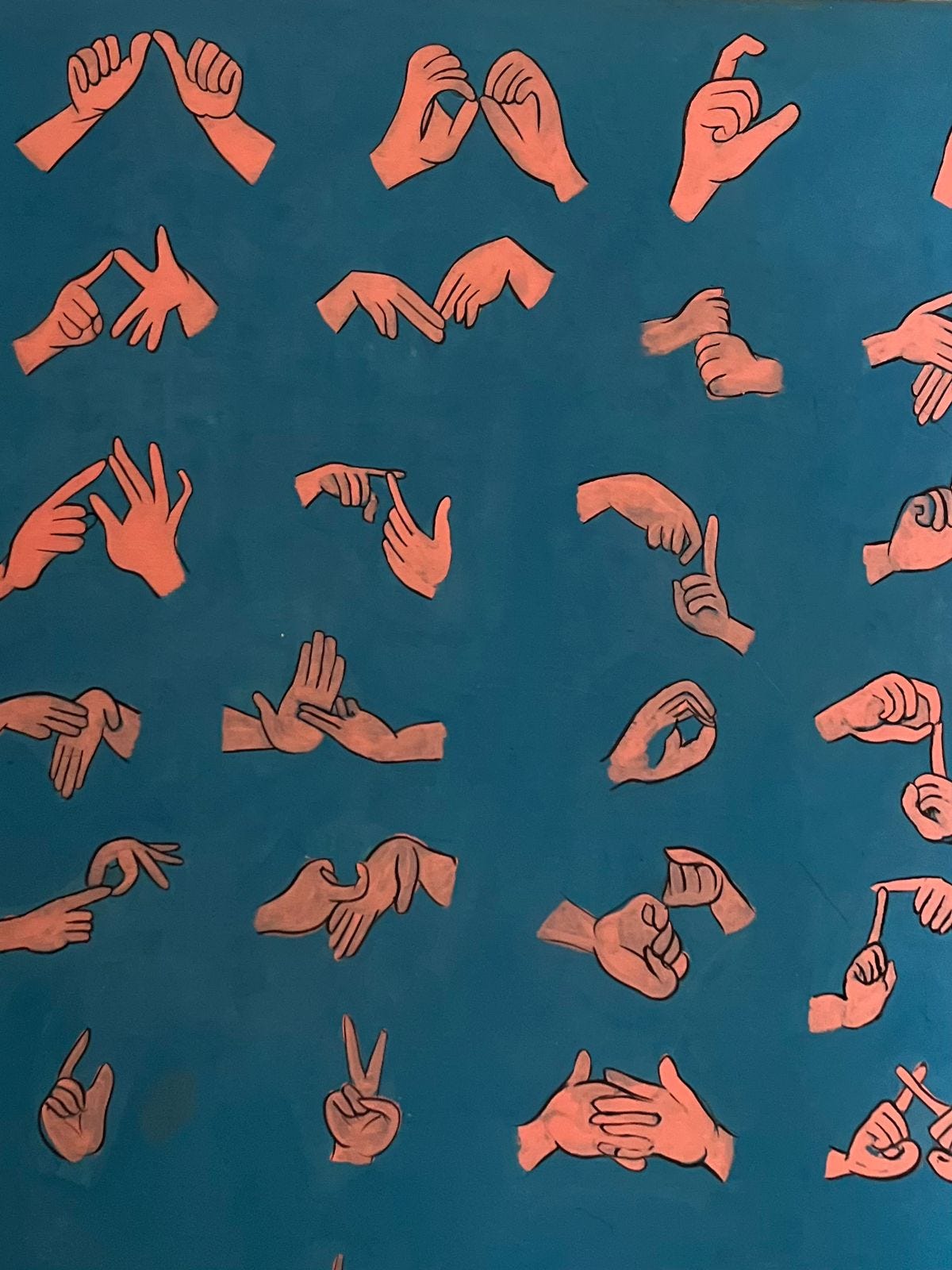
When I got to the school, I only had the hope of sitting beside the children on weekends and learning the language with a peer group— I had already learnt the basics on the Internet, but I would keep forgetting many words because I had nobody to practice it with. However, on that day, I somehow found myself on a new journey I had not anticipated. The Principal, a charismatic woman who could scold or cajole you in her quintessential old Bangalore English and hand signs at the same time, didn’t ask me too many questions about what I came to the school for. She asked me if I was interested in volunteering, to which I nodded meekly, and I was immediately assigned to the Fourth Grade classroom to help with extra attention to a student who was weak in Math. I mustered up enough courage to take up my new task, fairly confident that my basics would rescue me for that day, completely underestimating how little I knew. In fact, amidst a school full of children, teachers, aayas, staff members and the security guard gesticulating with ease, I became the ‘silent’ one.
A glimpse of what recess looks like at a school for deaf children
This was the first time I met little Megha. Most of the kids at this school were bursting with energy and could keep chattering endlessly with their hands and facial expressions, but Megha was different - she was composed and observant, but always full of expression. She had the most innocent smile and the most curious eyes, grasping onto every word that I barely managed to sign. Megha appeared a little tense. I asked her what I generally ask everyone I meet now from the deaf community — My name is A-S-H-F-A-Q. What’s yours?. Her eyes widened, and she began signing each letter of her name ( Deaf people actually have ‘sign names’ for each other, obviously, because it makes much more sense to have one sign than a necklace of individual letters for a name ). I tried to replicate the signs of the letters along with her to figure out the name. It was my way of telling her, I have so much to learn from you before I teach you something today.
I met Megha again this Saturday. Today, we were doing subtraction, since Megha totally aced addition the last time. She can add any number, even carry forward from the ones to tens and then to hundreds. But subtraction was something she couldn’t wrap her head around. I wouldn’t blame her, though. For the first few minutes, I observed her subtract numbers the way she knew how. I found that she followed a very tedious process of drawing lines of both numbers on adjacent rows and cancelling out the smaller ones from the bigger ones.
I tried explaining that instead of drawing all the lines, why don’t you just count backwards? Say 12 minus 5, would be counting five numbers backwards, which would give you 7. But turns out this was even more complicated for her. I was trying to figure out whether it was my signing she couldn’t understand, or if she struggled to count numbers backwards. Megha, the poor little soul, however, nodded along to everything I signed to her, which made me even more confused about where I’m going wrong. It’s not that Megha doesn’t understand subtraction; she could subtract numbers, carry forwards and do double-digit problems too. But she memorised this so robotically that she couldn’t do it any other way. She would carry forward even for a 12 minus 5, or draw the sticks, which would get so tedious with bigger problems.
So now I had to change my approach; I wanted to help her do this in her mind. I began to explain how counting backwards worked, one number at a time. I held out 12 in my fingers, and then dropped 5. She followed, but when I asked her to do 11 minus 4, she got confused again. Maybe, I thought, she simply didn’t understand what the mathematical operation was about in the first place. I looked around, and luckily I found a stack of paper cups. I took 11 of them and placed them in front of her, and asked her if she could subtract 4 from here. She was visibly confused, which was an aha moment for me. The poor girl struggled to understand how this really worked (that or my sign communication is disastrous). So I demonstrated how to subtract 4 from 11 using the cups. Now I let her do 12 minus 5 again. She was quick and counted 7 cups gleefully. Now I took away the cups and asked her to do 12 minus 6. Something clicked, and she figured out how to do this, counting 12 on her fingers and taking away 6 much quicker. Then I gave her bigger numbers, 15 minus 8, 25 minus 12, and 23 minus 18, which she figured much more quickly.
My guess was right, the girl knew how to subtract, but did not really understand what was happening. Maybe it was a good thing I had a very limited vocabulary; maybe I wouldn’t have tried to explain the same thing in different ways otherwise. Essentially, I realised, teaching is simply about trying to speak to a child in their own language, which might be different to each child in their own heads, even if our tongues spoke (or hands signed) the same words.
Whatever much I have been able to do, I would say the lessons I have learnt from these kids are much more valuable than what I’ve imparted. From conversation starters to prepositions and helping verbs, and even the one-hand alphabet, I picked these up solely from these students. I love getting up early on a Saturday morning to go watch these children with this infectious energy that never ran out, and they would keep chatting endlessly, with so much eagerness and animated expression on their faces. There’s a line in this short film, Ankahi (from the Ajeeb Dastaan anthology), where Manav Kaul’s character says, Your lips can always lie, but your eyes always tell the truth. That honesty is what I found in abundance in those little innocent faces at the school, and what brings me back to the same place every week.
what a beautiful anecdote, thank you for writing this
Thank you for writing this. It’s the kind of story that quietly restores your faith in small, human interactions. <3